“Compute to Heat”: Reusing Data Centre and Edge Inference Heat in Cities — Economics and Constraints in 2026

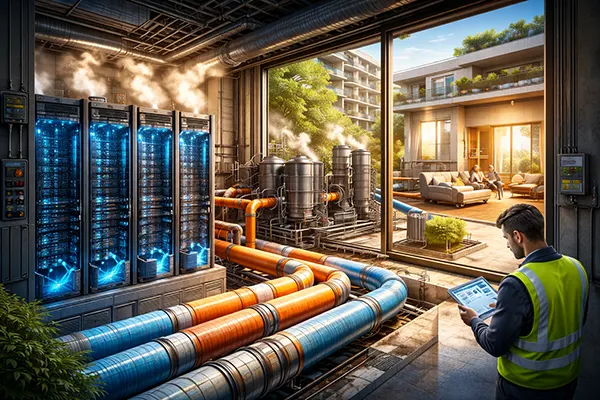
By 2026, the rapid growth of cloud computing, AI training and edge inference has turned data centres into one of the most concentrated new sources of low-carbon waste heat in urban areas. The concept often described as “compute to heat” reframes digital infrastructure not only as an electricity consumer but also as a distributed heat producer. Instead of releasing thermal energy into the air or water, operators are increasingly integrating their facilities into district heating networks, residential developments and public buildings. This article examines the real economics behind such projects and the technical and regulatory limits that determine whether they succeed or remain pilot schemes.
The Technical Basis: Where the Heat Comes From and How It Is Captured
Modern data centres convert nearly all consumed electricity into heat. Servers, GPUs and networking equipment operate within tight thermal envelopes, and cooling systems are designed to remove that heat continuously. In AI-heavy facilities, particularly those running high-density GPU clusters for training and inference, rack power densities in 2026 commonly exceed 30–60 kW, with some liquid-cooled AI racks surpassing 100 kW. This concentration makes heat capture technically attractive.
Two principal cooling approaches dominate: advanced air cooling and liquid cooling. Air systems exhaust warm air at temperatures typically between 30–45°C, which is often too low for direct use in conventional district heating without temperature boosting. Liquid cooling, including direct-to-chip and immersion systems, can provide outlet temperatures of 45–60°C or more, improving integration prospects and reducing the need for large heat pumps.
To make urban reuse viable, most projects rely on industrial-scale heat pumps that lift waste heat to 65–80°C for compatibility with existing district heating networks. In Northern Europe, where fourth-generation low-temperature networks are expanding, lower supply temperatures (50–60°C) reduce conversion losses and improve overall system efficiency. Integration requires careful hydraulic design, redundancy planning and synchronisation between IT load profiles and urban heat demand.
Edge Inference as a Distributed Urban Heat Source
Unlike hyperscale campuses located outside cities, edge inference nodes are increasingly embedded within metropolitan areas: telecom exchanges, retail basements, mobility hubs and micro data centres supporting 5G and AI services. Their electrical loads are smaller, typically from tens to a few hundred kilowatts, but their proximity to consumers reduces distribution losses and opens new architectural possibilities.
In 2026, several European cities are piloting “building-integrated compute rooms” where edge servers provide local AI processing while their waste heat supplies domestic hot water or contributes to space heating. Because inference workloads can be relatively stable compared to training clusters, their thermal output is more predictable, which simplifies integration into building management systems.
However, scale remains a constraint. A single edge node may only heat a portion of a residential block or public facility. To create system-level impact, municipalities must coordinate multiple sites, standardise interfaces and ensure cybersecurity and operational resilience, especially when digital infrastructure becomes partially tied to essential heat supply.
Real Economics in 2026: CAPEX, OPEX and Payback Periods
The financial viability of compute-to-heat projects depends on three interacting variables: local heat prices, electricity prices and carbon policy. Capital expenditure includes heat exchangers, high-capacity heat pumps, connection to district heating pipes and control systems. For medium-sized facilities in Europe in 2026, additional investment for full heat recovery integration can range from several million to tens of millions of pounds or euros, depending on distance to the network and required temperature lift.
Operating expenditure is influenced primarily by electricity consumed by heat pumps and auxiliary systems. When grid electricity prices are high, the margin between recovered heat revenue and additional electricity cost narrows. Conversely, in markets with abundant renewable generation and negative or low wholesale prices during off-peak hours, operators can improve project economics by aligning heat pump operation with favourable tariffs.
Payback periods reported in publicly documented European projects as of 2026 often fall between five and ten years, assuming stable district heating contracts and moderate carbon pricing. Where carbon taxes or emissions trading schemes penalise fossil-based heat production, recovered heat becomes more competitive. Long-term heat purchase agreements between utilities and data centre operators are therefore central to de-risking investments.
Business Models and Contract Structures
Three main commercial models are visible in 2026. In the first, the data centre operator invests in heat recovery equipment and sells heat directly to a district heating utility under a fixed-price contract. In the second, the utility finances and operates the recovery infrastructure, paying the operator for access to waste heat. In the third, a joint venture structure shares capital costs and revenue streams, aligning incentives over 15–25 years.
Risk allocation is a decisive factor. Utilities require guarantees of minimum thermal output, while operators seek protection against IT load reductions that could reduce available heat. As AI workloads can shift between regions for latency or cost reasons, contracts increasingly include flexibility clauses and minimum capacity commitments.
Public co-funding, particularly through EU and UK decarbonisation programmes, continues to play a catalytic role. Grants or low-interest loans can reduce upfront barriers, especially for retrofitting existing facilities. Nevertheless, without clear long-term heat demand and stable regulation, purely market-driven replication remains uneven across regions.
Structural Constraints: Grid, Climate and Urban Planning Limits
Despite technical feasibility, not every data centre is a good candidate for urban heat reuse. Location is critical. Facilities situated far from dense heat demand require costly pipeline extensions, which can outweigh energy benefits. In warmer climates, annual heat demand is lower, reducing load factors and weakening the business case compared to Nordic or Baltic countries.
Grid constraints also matter. If a region’s electricity supply is carbon-intensive, the overall climate benefit of using heat pumps may be reduced. Lifecycle assessments in 2026 increasingly evaluate not only avoided fossil heat but also marginal grid emissions at different times of day. Projects therefore integrate smart control strategies to operate heat pumps when renewable penetration is highest.
Urban planning and regulatory frameworks add further complexity. Heat networks are often regulated monopolies, and connection rights, tariff structures and technical standards vary widely. Retrofitting older buildings to accept lower-temperature heat can require additional investment in radiators or insulation, which must be coordinated across property owners.
Operational and Reliability Challenges
Digital infrastructure prioritises uptime, often targeting availability levels above 99.99%. Heating networks, while critical, traditionally operate with different redundancy assumptions. When heat recovery becomes integrated, both sectors must reconcile standards for backup, maintenance windows and emergency procedures.
Seasonal imbalance presents another constraint. Data centres generate heat year-round, whereas peak urban heat demand occurs in winter. In summer, surplus heat may exceed local needs unless absorbed by domestic hot water demand, industrial processes or seasonal thermal storage systems. Large-scale hot water tanks or borehole storage fields can mitigate this mismatch but add capital costs.
Finally, strategic alignment is essential. Compute-to-heat only delivers systemic value if integrated into broader urban decarbonisation strategies, including building renovation, electrification and renewable expansion. Without coordinated planning, projects risk remaining isolated showcases rather than core infrastructure components of low-carbon cities in the late 2020s.