Liquid Cooling for AI Servers: How Data Centres Prevent Powerful Processors from Overheating
Artificial intelligence is changing the way data centres manage heat. Powerful graphics processing units (GPUs) can perform enormous numbers of calculations, but they also generate substantial amounts of heat during demanding workloads. Traditional air cooling is increasingly difficult to use in densely packed AI server racks, where dozens of processors may operate simultaneously. Liquid cooling offers a more effective way to remove this heat, protect expensive equipment and support continuous processing. By 2026, the technology has become an important part of modern AI infrastructure, particularly in facilities designed for large language models, scientific research and high-performance computing.
Why AI Servers Need More Advanced Cooling Systems
Conventional data centres have historically relied on fans, air conditioning and carefully arranged ventilation systems to maintain suitable temperatures. Cold air enters the front of server cabinets, passes through the equipment and carries heat towards the rear. This approach remains effective for many ordinary computing workloads. However, AI servers introduce a different challenge because they concentrate considerable processing power within a relatively small space. When numerous accelerators operate continuously, the amount of heat produced can exceed what conventional air circulation can remove efficiently.
The increasing electrical demands of AI hardware illustrate the scale of this problem. NVIDIA’s GB200 NVL72 system, for example, combines 72 Blackwell GPUs and 36 Grace CPUs within a single liquid-cooled rack. According to NVIDIA’s technical documentation, a DGX GB200 rack can consume approximately 120 kW of electrical power. Almost all electricity consumed by computing equipment ultimately becomes heat that must be removed. Managing such a concentrated thermal load requires considerably more than simply installing additional fans or lowering the temperature of the surrounding room.
Excessive temperatures can affect performance, reliability and operating costs. Modern processors contain protective mechanisms that reduce their operating speed when temperatures approach specified limits, a process known as thermal throttling. This prevents immediate damage but can slow calculations and increase the time required to complete AI workloads. Persistent thermal stress may also affect surrounding components and contribute to hardware failures. For organisations operating thousands of expensive accelerators, effective cooling is therefore essential not only for equipment protection but also for maintaining predictable computing performance.
Why Traditional Air Cooling Struggles with High-Density AI Hardware
Air has a relatively low capacity to carry heat compared with water and other suitable cooling liquids. Removing increasing amounts of heat through airflow requires more powerful fans, larger ventilation systems and carefully controlled air movement. These improvements consume electricity and may occupy valuable space inside the facility. At higher server densities, simply increasing airflow becomes increasingly difficult because air must travel through restricted spaces around processors, memory modules, cables and other components.
Another difficulty involves the distribution of heat inside server racks. Not every processor operates at the same temperature, and particular components may create concentrated hot spots. Even when the average room temperature remains acceptable, individual chips can approach their thermal limits. Large AI training tasks make this problem particularly challenging because many GPUs operate under heavy loads for extended periods. Cooling systems must respond to these conditions without allowing localised temperature increases to interrupt processing or reduce the performance of expensive computing equipment.
Traditional air cooling is not disappearing, however. Many storage devices, networking components and lower-density servers can continue operating efficiently with conventional fans. Even advanced liquid-cooled AI systems often retain airflow for components that are not connected to liquid circuits. The practical challenge for data centre operators is deciding which equipment requires direct liquid cooling and which components can remain air-cooled. This combined approach allows facilities to introduce higher-density computing without unnecessarily replacing every part of their existing cooling infrastructure.
How Liquid Cooling Removes Heat from AI Processors
Liquid cooling works by transferring heat from electronic components into a circulating fluid, which carries that heat away for disposal or reuse. Because suitable liquids can transport considerably more heat than air under comparable conditions, cooling can take place close to the components producing the greatest thermal load. The process reduces dependence on large volumes of airflow and provides more direct temperature control. However, liquid cooling is not a single technology: several different approaches are available, each with its own equipment requirements, maintenance considerations and installation costs.
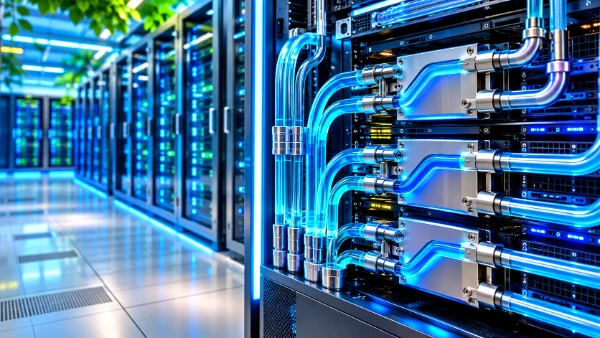
Direct-to-chip cooling is one of the most widely adopted approaches for powerful AI servers. Specially designed metal components known as cold plates are attached to processors and other heat-producing chips. Cooling liquid circulates through narrow channels inside these plates, absorbing heat before returning to a distribution system. The liquid does not normally touch the electronic circuits themselves. This arrangement makes it possible to cool selected components directly while retaining fans for memory, power supplies and other parts that still require airflow.
Immersion cooling provides an alternative method. Instead of directing liquid through cold plates, specially designed servers or electronic components are submerged in an electrically insulating fluid. In single-phase systems, the liquid absorbs heat while remaining in its liquid state. Two-phase systems use a suitable fluid that boils at its operating temperature and subsequently condenses for reuse. Immersion cooling can reduce dependence on server fans, but it also introduces different servicing procedures, fluid compatibility requirements and equipment designs. Consequently, it is not automatically the most practical choice for every AI installation.
The Role of Cold Plates, Cooling Distribution Units and Heat Exchangers
A typical direct-to-chip system consists of several connected elements. Cold plates collect heat from processors, flexible hoses transport the cooling liquid, and distribution manifolds deliver the required flow to individual servers. A cooling distribution unit, commonly called a CDU, manages circulation and transfers heat between the equipment’s cooling circuit and the facility’s cooling infrastructure. Heat exchangers usually keep these circuits physically separate, helping maintain appropriate liquid quality and operating conditions around sensitive electronic components.
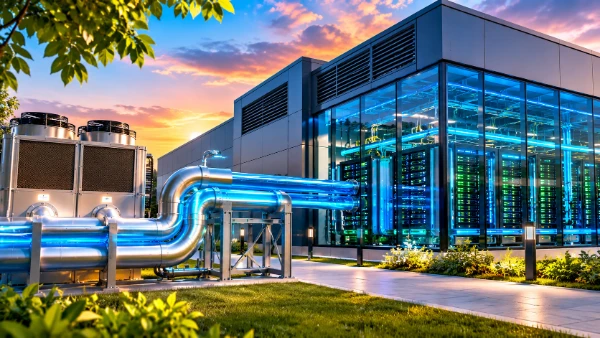
Once the liquid leaves the servers, the captured heat must be transferred elsewhere. Depending on the building design and local climate, facilities may use dry coolers, cooling towers, chillers or other heat-rejection equipment. Some systems can operate with relatively warm cooling water, reducing the need for energy-intensive refrigeration. ASHRAE defines several facility-water temperature classes, including W17, W27, W32, W40 and W45, to support equipment selection and cooling-system design. These classifications describe permitted facility supply temperatures rather than universal operating temperatures for individual processors.
Reliable operation also depends on monitoring and safety measures. Sensors track liquid temperature, pressure, flow rate and potential leaks, allowing operators to identify abnormal conditions before they affect computing equipment. Filtration, appropriate water chemistry and compatible materials help prevent corrosion and deposits inside cooling circuits. Some installations incorporate redundant pumps and isolation valves so that individual components can be serviced without shutting down an entire facility. These precautions are particularly important in AI data centres, where cooling failures can interrupt expensive computing tasks and affect multiple interconnected servers.
Benefits, Challenges and the Future of Liquid-Cooled AI Data Centres
One of the main advantages of liquid cooling is the ability to accommodate greater computing power within a limited physical area. Higher rack densities allow operators to install large AI systems without spreading equipment across numerous rooms or buildings. Liquid cooling can also reduce the electricity required for fans and certain refrigeration processes, although actual savings depend on climate, hardware, cooling temperatures and facility design. A 2026 report from the IEA’s Energy Efficient End-use Equipment initiative estimated potential overall energy savings of approximately 10–21% for liquid-cooled data centres under the conditions examined.
These advantages must be considered alongside the costs of installation and maintenance. A conventional facility may require new pipework, cooling distribution units, electrical upgrades, leak-detection equipment and modifications to server cabinets. Staff also need appropriate training to maintain liquid circuits and replace hardware safely. Retrofitting an existing building can be particularly complicated if its layout was designed for low-density air-cooled servers. For this reason, operators increasingly evaluate cooling requirements alongside electrical capacity and equipment selection rather than treating them as separate decisions.
Environmental performance is another important consideration. Liquid cooling does not automatically eliminate water consumption, and some facilities still rely on evaporative cooling towers that consume water during heat rejection. Others use closed-loop circuits combined with dry coolers, which can reduce ongoing water requirements but may involve different energy and capital costs. Energy efficiency must therefore be assessed together with local water availability, electricity demand and operating conditions. The most appropriate design for a cool European location may differ substantially from one installed in a hot or water-stressed region.
How Liquid Cooling Is Shaping the Next Generation of AI Infrastructure
By 2026, liquid cooling has become closely associated with high-density AI hardware. NVIDIA’s GB200 and GB300 NVL72 systems demonstrate how manufacturers are designing complete computing racks around integrated liquid-cooling arrangements rather than treating cooling as an optional addition. At the same time, operators must consider compatibility between different server generations, cooling connections and existing infrastructure. Standardised components and clearer equipment specifications can help reduce installation complexity, particularly in facilities that purchase hardware from several manufacturers.
Another developing opportunity is the reuse of heat produced by AI servers. Because liquid can collect heat at relatively high temperatures, some installations can transfer it to building heating systems or district heating networks. The usefulness of recovered heat depends on its temperature, the distance to potential customers and the availability of heating demand. Heat pumps may be required where the recovered temperature is insufficient. Although heat reuse cannot eliminate the electrical demands of AI computing, it can provide an additional benefit where suitable local infrastructure exists.
The long-term success of liquid cooling will depend on more than its ability to keep processors within safe temperatures. Data centres need systems that remain dependable, are practical to maintain and can accommodate future hardware without repeated major reconstruction. For large AI installations, direct-to-chip cooling is already an established option, while immersion cooling and other designs provide alternatives for particular requirements. As processors become more powerful and server racks accommodate greater computing capacity, thoughtful thermal management will remain a central consideration in building efficient and reliable AI infrastructure.