Light Fields and Holographic Displays: Glasses-Free 3D Imaging in 2026
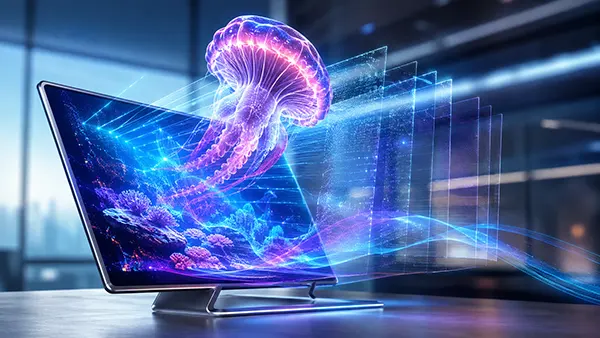
Three-dimensional displays no longer depend entirely on coloured spectacles, active shutter glasses or bulky headsets. By controlling the direction, intensity and, in some cases, the wave properties of light, modern systems can present objects with visible depth on or in front of a screen. A viewer may look around a digital model, notice different details after moving sideways and judge the relative position of its parts without wearing additional equipment. Commercial products available in 2026 already support design reviews, medical visualisation, education, museum exhibits and interactive installations. However, the phrase “holographic display” is often applied loosely, so understanding the difference between light-field, autostereoscopic, volumetric and true holographic technologies is essential when assessing what a device can actually do.
How Glasses-Free 3D Displays Create a Sense of Depth
Human vision does not rely on a single depth signal. The brain compares the slightly different image received by each eye, observes how nearby objects shift when the head moves and changes the focus of the eyes according to distance. Ordinary screens reproduce colour and brightness on a flat surface, but they send essentially the same image in every direction. A glasses-free 3D display must provide additional visual information so that the left and right eyes receive appropriate views. More advanced systems also change the perspective as the viewer moves, creating motion parallax similar to that produced by a physical object.
Many current products use a lenticular lens sheet or another fine optical layer placed over an LCD or OLED panel. The layer redirects groups of subpixels towards different viewing positions. The screen therefore displays several slightly shifted versions of the same scene at once, and each eye sees a different version. Some systems create only two principal views and use face or eye tracking to keep them aligned with one viewer. Others generate dozens of views across a wider viewing cone, allowing several people to see changing perspectives from different positions.
This method is effective, but the available pixels must be divided between the separate views. A screen with a high two-dimensional resolution can therefore produce a noticeably lower effective resolution in 3D mode. Increasing the number of views improves movement around the image, yet it can reduce sharpness, brightness or both. Designers must balance screen size, viewing angle, image detail, depth range and the number of viewers. This compromise remains one of the central engineering problems in glasses-free 3D, even as denser panels and better optical components improve the results.
Light Fields, Holography and Volumetric Images Are Not the Same
A light field describes not only the amount of light present at a point but also the direction in which that light is travelling. A light-field display recreates part of this directional information by emitting different rays towards different viewing positions. When a digital object is rendered from many angles, the observer sees the correct side of it while moving across the viewing zone. The object may appear to sit behind the screen or extend towards the viewer, although the light still originates from the display surface and its optical layers.
True holography works at a more fundamental level. Instead of directing a set of finished perspective images, a holographic system attempts to reconstruct the light wavefront that would have been produced by a real object. This requires control over the phase as well as the intensity of light. In principle, accurate wavefront reconstruction can provide natural parallax and focus cues, allowing the eyes to focus at different simulated distances. Dynamic systems normally rely on spatial light modulators, carefully controlled illumination and extensive calculations that determine the pattern required for every frame.
A volumetric display takes another approach by producing visible points within an actual three-dimensional region. These points may be created on a rapidly moving surface, inside a transparent material or through controlled particles. Because light is emitted or scattered from physical positions in the volume, observers can often walk around the image. The method is distinct from both multiview screens and holographic wavefront reconstruction. In everyday marketing, all three categories may be described as holographic, but a convincing appearance of depth does not automatically mean that a device creates a free-standing hologram in open air.
Glasses-Free 3D Hardware Available in 2026
The commercial market in 2026 includes desktop monitors, portable screens and larger installation displays. Most are intended for professional visualisation, specialist entertainment or public presentation rather than general television viewing. Their designs vary considerably. Some optimise a stereo image for one tracked viewer, while others distribute many perspectives across a fixed viewing cone. This difference affects where people can stand, how many can watch at once and whether the perspective changes smoothly when they move.
Sony continues to sell 15.6-inch and 27-inch Spatial Reality Displays, with the larger ELF-SR2 offering a 4K panel. A camera-based eye-sensing system detects the viewer’s face and adjusts the image according to the viewing position. Acer uses a related combination of eye tracking and lenticular optics in its SpatialLabs range. The 27-inch SpatialLabs View Pro model can switch between 2D and stereoscopic 3D, has a 3840 × 2160 panel and supports a refresh rate of up to 160 Hz. These devices are suited to individual work with computer-generated models, although correct positioning and compatible software remain important.
Looking Glass follows a multiview light-field approach designed for shared viewing. Its 27-inch display has a 5K panel, generates up to 100 views and provides a viewing cone of approximately 53 degrees without requiring eye tracking. The company also introduced 16-inch and 27-inch hololuminescent displays, which combine high-resolution panels with a controlled depth volume and content effects intended to create a strong sense of physical presence on a thin screen. The Society for Information Display named these models among its 2026 Displays of the Year, indicating that glasses-free spatial imaging has progressed beyond isolated laboratory demonstrations, even though it remains a specialised product category.
Where the Technology Already Provides Practical Value
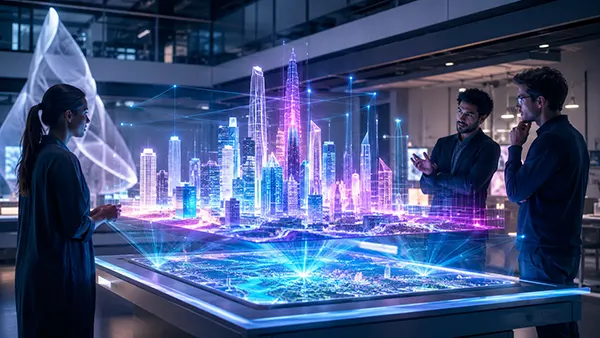
Engineering and product design are among the clearest applications. A three-dimensional model of a vehicle component, building, machine or consumer product can be presented at a useful scale without requiring every participant to wear a headset. Designers can inspect surface relationships, internal layers and spatial proportions while continuing to see colleagues, notes and physical equipment around them. Light-field displays are particularly useful during presentations because several people can observe the same model from nearby positions and discuss visible details without passing equipment between them.
Medical and scientific visualisation can also benefit from direct depth perception. Data from computed tomography, magnetic resonance imaging, microscopy or molecular modelling is naturally three-dimensional, yet it is usually viewed as flat slices or as a perspective rendering on a standard monitor. A spatial display can make overlapping structures easier to separate visually and can help users understand complex geometry. It does not replace clinical interpretation or validated diagnostic equipment, but it can support teaching, case discussion, surgical planning research and communication with patients when the content has been prepared correctly.
Museums, visitor centres, education spaces and branded installations use glasses-free displays because they remove the hygiene, supervision and maintenance issues associated with shared headsets. A digital artefact can rotate, respond to touch or present reconstructed details that would be difficult to show on a flat screen. Similar systems can support remote presence, digital characters and product demonstrations. Their value depends less on visual novelty than on whether depth makes the subject easier to understand. Poorly prepared content, exaggerated depth or an unsuitable viewing distance can turn an otherwise advanced display into an uncomfortable and uninformative experience.
The Barriers Between Specialist Displays and Everyday Screens
The main physical limitation is the finite amount of visual information a screen can deliver. High spatial resolution requires many pixels for fine detail, while a wide viewing angle requires many directional samples. Supplying both at the same time demands an enormous number of controllable picture elements. When the available information is divided among too many views, fine text and edges become softer. If the number of views is reduced, users may notice abrupt jumps between perspectives or narrow positions where the 3D effect works correctly. Eye tracking can concentrate resources around one observer, but it introduces tracking delay and makes group viewing more difficult.
Content preparation is another significant obstacle. A conventional photograph or film contains only one camera view and cannot automatically provide all the hidden surfaces required when an observer changes position. High-quality light-field content may come from a complete 3D model, a multi-camera capture system, depth sensors or computational reconstruction. Each additional view also increases rendering and data-processing requirements. Real-time scenes may need dozens of perspectives per frame, placing a heavy load on the graphics processor. Artificial intelligence can estimate depth and generate missing information, but guessed geometry may produce unstable edges, distorted faces or incorrect backgrounds.
Practical issues include brightness, colour consistency, restricted viewing positions, cost and visual comfort. Directional optical layers can reduce the amount of light reaching the viewer, while crosstalk may allow one eye to see part of the view intended for the other. Excessive depth can cause fatigue when binocular depth signals do not agree with the fixed physical distance of the screen. Specialist displays also require compatible computers, cables, drivers and content tools. Until installation and content workflows become as predictable as those for normal monitors, most buyers will need a clearly defined professional use rather than a general interest in 3D.
What the Next Generation Is Likely to Change
Recent research shows that software can use display resources more efficiently. The EyeReal prototype reported in late 2025 combines binocular modelling with deep-learning optimisation to direct useful light-field information towards the viewer’s eyes. Its developers demonstrated full parallax over a viewing range exceeding 100 degrees, a refresh rate above 50 Hz and a spatial resolution of 1920 × 1080 using a monitor-sized arrangement. The system is a research prototype rather than a mass-market product, but it demonstrates how intelligent allocation of light can reduce the traditional conflict between display size and viewing angle.
A 2026 Nature Photonics study presented a scanning light-field system with a 150-degree viewing angle. The design combines a specialised lenticular lens array with synchronised mechanical scanning to increase the sampling density perceived by the eye. Research in computer-generated holography is progressing in parallel, with neural calculations reducing the time required to produce holograms and improved optical designs addressing speckle, narrow viewing angles and limited focus quality. These results are important, although laboratory performance should not be treated as proof that an affordable consumer product is ready for large-scale production.
The most realistic near-term development is gradual improvement rather than the sudden arrival of room-sized free-floating images. Professional monitors will gain wider viewing zones, better 2D-to-3D conversion and simpler support for common design tools. Multiview displays will benefit from higher-resolution panels, while tracked displays will become more tolerant of head movement and varied lighting. True holographic systems are likely to appear first where their natural focus cues justify the cost, including advanced simulation, research and specialised visualisation. As of 2026, glasses-free 3D is already practical in selected settings, but its wider adoption depends on better content, lower prices and a careful match between each display method and the task it is meant to perform.